
An Urban Duality
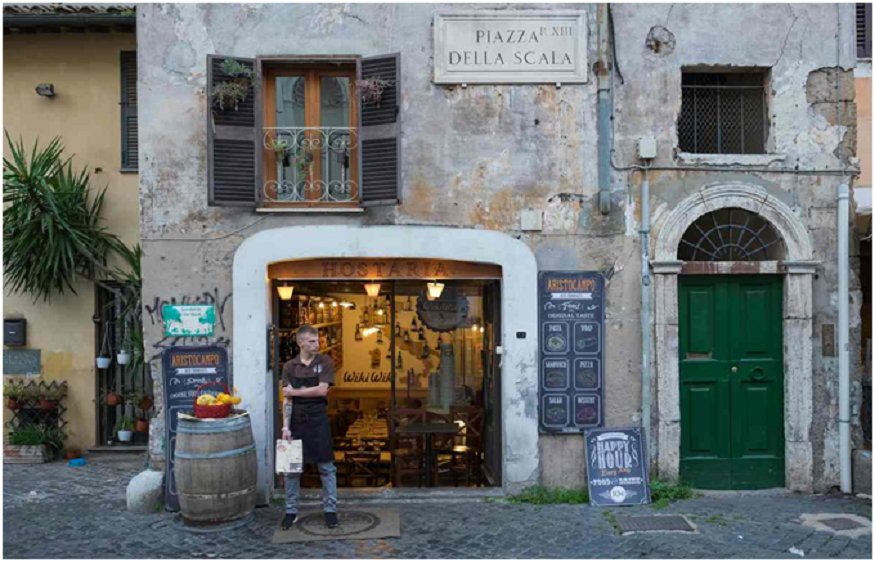
Trastevere occupies a singular position within the urban fabric of Rome. Located on the west bank of the Tiber, it is often characterized by an apparent contradiction: an environment defined simultaneously by intensity and restraint. Its public image is one of animated streets, dense with social activity and frequented by both residents and visitors. Yet this perception captures only part of its reality. Beneath its visible liveliness lies a quieter spatial structure, composed of enclosed courtyards, secondary alleys, and transitional zones that temper the outward dynamism. The coexistence of these conditions produces a layered experience that resists reductive interpretation.
The Dynamics of Noise and Movement
At the level of primary circulation, Trastevere presents itself as an environment of movement and sound. Narrow streets amplify voices and footsteps, while restaurants and bars extend their presence into public space. This concentration of activity is not incidental but structurally embedded in the district’s morphology. The irregular street pattern, inherited from medieval development, channels flows of people into compressed corridors, intensifying the perception of density. In such settings, sound becomes a defining element, shaping both the character and the tempo of the neighborhood.
Read More: Why Holiday Inn Resort Krabi Stands Out Among the Best Ao Nang Beach Hotels
Thresholds and Spatial Retreat
However, the same structural features that generate intensity also create opportunities for withdrawal. Trastevere is characterized by a series of thresholds—doorways, archways, and passageways—that mediate between public and private space. Crossing one of these thresholds often leads to a markedly different environment: a courtyard shielded from street noise, a cloistered garden, or a quiet residential lane. These spaces do not advertise themselves; they are encountered through movement and attention. Their presence introduces a counterpoint to the surrounding activity, allowing for moments of pause within an otherwise continuous flow.
Temporal Variations in Experience
The perception of Trastevere is also contingent upon time. During daylight hours, the district maintains a moderate rhythm, with activity distributed across commercial and residential functions. As evening approaches, the balance shifts, and the streets become increasingly animated. Yet even at peak intensity, quieter zones persist, particularly in areas removed from main thoroughfares. Early morning, by contrast, reveals a different configuration entirely: the same streets that were crowded hours before appear nearly vacant, and the underlying architectural order becomes more legible. These temporal shifts reinforce the district’s dual character, demonstrating that noise and quiet are not fixed attributes but fluctuating conditions.
Structured Exploration and Informal Discovery
Engagement with Trastevere often benefits from a balance between preparation and openness. A loose sense of direction—whether derived from maps, prior knowledge, or even some ideas on how to spend your perfect day—can help establish an initial orientation without fixing the experience in advance. The district’s most distinctive qualities, however, rarely align with predefined routes. They tend to emerge in the spaces between intended destinations, where minor deviations lead to quieter streets or enclosed corners that remain largely unnoticed. Such moments are significant not for their rarity, but for the way they reveal the structural continuity between Trastevere’s more animated and more restrained environments.
Habitation and Interior Calm
The interplay between external intensity and internal calm extends to the experience of accommodation within Trastevere. Buildings that appear outwardly integrated into the dense urban fabric often contain interiors defined by proportion, light, and enclosure. A boutique luxury stay in Trastevere exemplifies a broader architectural principle: the capacity to create environments of repose within settings of high activity. Such spaces do not negate the surrounding vitality; rather, they provide a counterbalance, allowing the inhabitant to engage selectively with the district’s rhythms.
Read More: “How Global Tourism Is Evolving in 2026: Trends Shaping the Future of Travel”
Coexistence as Identity
The paradox of Trastevere is not a contradiction to be resolved, but a condition to be understood. Its identity derives precisely from the coexistence of opposing qualities—noise and silence, exposure and retreat, movement and stillness. These elements do not exist in isolation but interact continuously, producing a dynamic equilibrium. For the attentive observer, Trastevere offers more than a sequence of impressions; it provides a framework for understanding how urban environments can sustain complexity without losing coherence.